
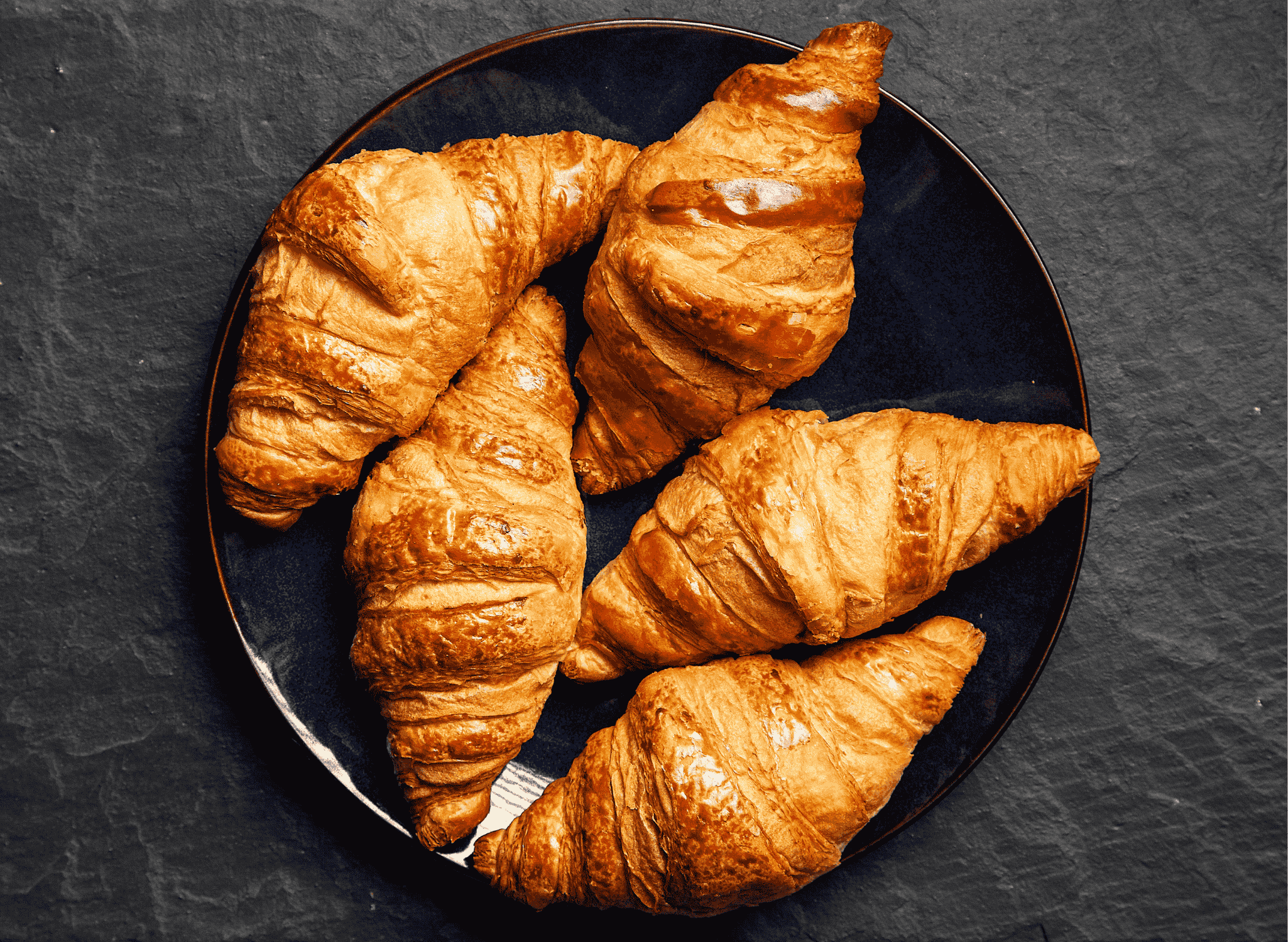
The croissant is one of the world’s most beloved pastries, instantly recognizable by its crescent shape and flaky, buttery layers. Though often associated with France, its origins actually trace back to Austria in the late 17th century. The predecessor of the croissant was the “kipferl,” a crescent-shaped bread that was enjoyed in Vienna. Legend says the kipferl was created to celebrate the victory of Austria over the Ottoman Empire, with its crescent shape mimicking the crescent moon on the Ottoman flag.
It was later introduced to France by Austrian bakers in the 18th century, where French pastry chefs refined it using laminated dough and rich butter, transforming it into the delicate, airy pastry we know today. By the 19th century, croissants had become a staple of French cafés and bakeries, closely tied to the culture of Parisian breakfasts.
A freshly baked croissant paired with coffee or hot chocolate became the epitome of French morning indulgence. Over time, There evolved into different variations: plain croissants, almond-filled croissants, chocolate-filled pains au chocolat, and even savory ones stuffed with cheese or ham. The craftsmanship of creating croissants—folding butter into dough repeatedly to create dozens of thin, flaky layers—made it a symbol of French patisserie artistry.
Today, There are not only popular in France but have become a global breakfast and snack item. From Europe to Asia and the Americas, bakeries and cafés proudly display trays of golden croissants, sometimes served with local twists such as matcha filling in Japan or spicy chicken in India. International coffee chains have also played a big role in spreading the popularity of croissants, offering them as a convenient on-the-go option. Despite these modern adaptations, traditional French croissants made with high-quality butter remain the benchmark of excellence.
There also carry a sense of luxury and comfort. Their delicate texture and rich taste make them suitable for special occasions as well as everyday enjoyment. Whether eaten plain, served with jam, or turned into a gourmet sandwich, croissants symbolize a celebration of fine baking. For many, the aroma of freshly baked croissants instantly transports them to a cozy Parisian café, highlighting how deeply this pastry is connected with culture, romance, and indulgence.
Ingredients (Makes 8 croissants)
- All-purpose flour – 2 ½ cups (300 g)
- Instant yeast – 2 tsp
- Sugar – 3 tbsp
- Salt – 1 tsp
- Milk – ¾ cup (180 ml), warm
- Unsalted butter – 2 tbsp (softened, for dough)
- Unsalted butter – 150 g (cold, for layering)
- Egg – 1 (for egg wash)
Steps
- In a mixing bowl, combine warm milk, sugar, and yeast. Let it rest for 5 minutes until frothy.
- Add flour, salt, and 2 tbsp softened butter. Knead until smooth, about 8–10 minutes. Cover the dough and let it rise for 1–2 hours until doubled in size.
- Punch down the dough and roll it into a rectangle. Place the cold butter block in the center and fold the dough over it to enclose.
- Roll the dough into a long rectangle and fold it into thirds like a letter. Wrap and refrigerate for 30 minutes.
- Repeat the rolling and folding process 3 times, chilling between each fold, to create multiple thin layers.
- After the final fold, roll the dough into a large rectangle about ¼ inch thick. Cut into long triangles.
- Roll each triangle from the base to the tip to form a crescent shape. Place them on a baking tray lined with parchment paper.
- Cover loosely and let rise for 1 hour until puffy. Brush with beaten egg for a golden finish.
- Preheat oven to 200°C (400°F) and bake these for 15–18 minutes until golden brown and flaky.
Health Benefits
Though croissants are often considered an indulgence, they do provide energy and some nutrients when eaten in moderation. Made with flour and butter, croissants are rich in carbohydrates and fats, which offer a quick energy boost. The yeast fermentation process can make the pastry easier to digest, while milk and butter contribute small amounts of protein and calcium. Choosing whole wheat flour or pairing croissants with fruit and a protein source can make them part of a more balanced meal. However, because of their high butter content, croissants are best enjoyed as an occasional treat rather than a daily staple.
Kitchen Tip: For the flakiest croissants, always keep the butter and dough cold during folding—this prevents the butter from melting and ensures perfect layers.